This post may contain affiliate links. As an Amazon Affiliate, I may earn a small commission from qualifying purchases at no extra cost to you. Read the full disclaimer here.
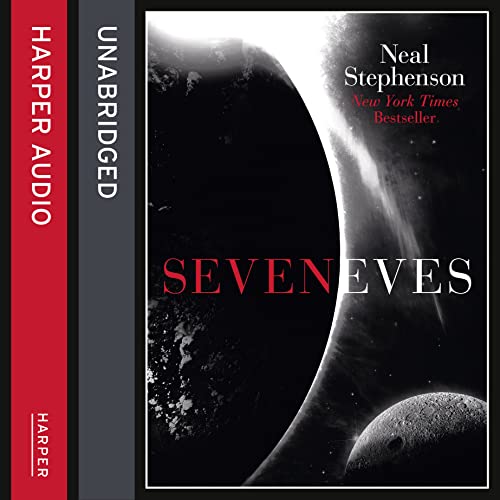
The first sentence of Seveneves is: “The moon blew up without warning and for no apparent reason.” If that sentence makes you want to keep reading, this book might be for you. If it makes you want an explanation immediately, you should probably know that the explanation never fully comes — and that Stephenson is considerably more interested in what happens next than in why it happened.
Seveneves is not a novel for everyone. It is a novel for people who want to understand, in considerable technical detail, exactly how humanity might survive the destruction of the moon. If that sounds like a good Saturday, read on.
What’s It About?
When the moon fragments, orbital mechanics creates a situation called the White Sky and then the Hard Rain — a period of roughly two years of grace before the moon’s fragments begin raining down on Earth, burning the atmosphere and rendering the surface uninhabitable for thousands of years.
Humanity has two years to get as many people as possible into orbit. The first two-thirds of the novel follows that effort — the politics, the engineering, the human drama of building an ark in space under impossible time pressure. It ends with a small population of survivors in orbit as Earth burns below them.
The final third jumps five thousand years into the future to the world those survivors have built.
The Science
Stephenson is a meticulous researcher and Seveneves is essentially a hard science fiction novel masquerading as a thriller. The orbital mechanics are real. The engineering challenges are real. The biology of long-term space habitation is addressed with genuine rigour. If you’ve ever wanted to understand how space stations actually work, what orbital debris fields mean for human survival, or how you’d go about rebuilding human civilisation from a genetic bottleneck — this book is remarkable.
It’s also, in stretches, a lot of information delivered with minimum narrative dressing. Stephenson trusts his readers to want the details. Not everyone does.
The Characters
The cast is large and mostly functional. Dinah MacQuarie, an asteroid-mining roboticist who becomes central to the orbital survival effort, is the most rounded. Doob — a Neil deGrasse Tyson-adjacent astrophysicist who becomes humanity’s explainer-in-chief — is clearly based on a real person and rendered with affection. Several characters are clearly analogues of living public figures, handled with varying degrees of subtlety.
The characters are the weakest element. Stephenson is a ideas writer first and a people writer second, and in a 900-page novel that’s sometimes a problem.
The Third Act
The five-thousand-year jump is the most controversial element. Readers who’ve been emotionally invested in the orbital-ark storyline often find it jarring — a new cast, a new world, characters they don’t know yet. It asks a lot.
It also contains some of the most inventive worldbuilding in the book. The seven genetically distinct races descended from the seven survivors — each named for one of the founding women — and the political tensions between them are fascinatingly worked out. Stephenson has done the genetics, the culture, the architecture of a post-catastrophe orbital civilisation. The detail is extraordinary.
Whether the payoff justifies the jarring transition is a genuine question. I think it does.
Should You Read It?
If you love hard science fiction and have patience for technical depth in prose: absolutely. If you want primarily character-driven story and accessible narrative: try The Long Way to a Small, Angry Planet instead. Seveneves is a specific kind of fiction for a specific kind of reader, and for that reader it’s one of the best hard sci-fi novels of the decade.
Rating: 4/5
Rated 3.9 Stars on Amazon. Buy Seveneves here.
You Might Also Like
- Empire of Silence Review
- The Long Way to a Small, Angry Planet Review
- Becky Chambers Books in Order
- The Best Sci-Fi Books by Ursula K Le Guin
Check out Sunset In the East — a mind-bending short story collection from Ben Luxon.